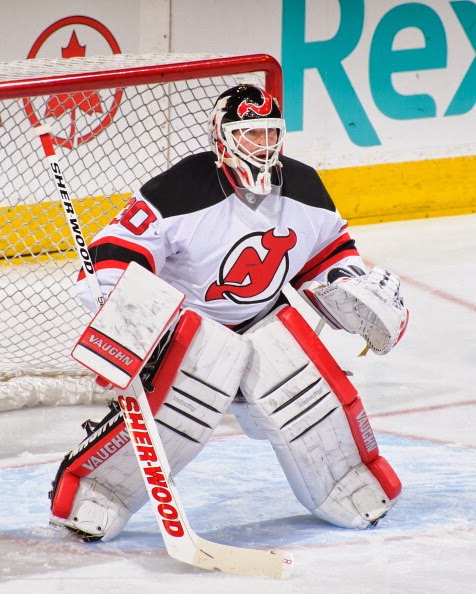
The key to a goalie’s playing style is the basic ready stance. The basic ready stance is the starting point of every save. It is from this starting position that a goalie “explodes” toward the puck in any given direction to place the body or part of the body in front of a shot to make a save. Just as it is problematic to label a goalie with a certain style for the reasons discussed in the previous section, defining a goalies style by the stance they normally use is also not favorable, because goalies need to use different stances depending on the situation. As Kevin Constantine, former San Jose Shark, Pittsburgh Penguin and New Jersey Devils coach, points out “Certain stances are better in certain situations. Each stance has its advantages and disadvantages. For example, a closed stance is best for handling bad angle shots: the butterfly stance is best in screen and deflection situations; and the open stance is best for lateral movement. So a goaltender should be ready to use all stances though most goaltenders will be more comfortable with a certain stance.”9 Corsi and Hannon add, “Today’s game has shown (and this is especially evident in the development of Dominik Hasek and Martin Biron) that a goalie must not lock into one particular style. Your ready stance will identify your starting point, but your save skills should be indifferent to your style.” 10
It is extremely important that coaches realize these differences in stances and that a different stance is used depending on the situation and that they teach these skills to their goalies. Because differences in the goalie’s starting position make certain types of fundamental saves easier for goalies, coaches must work on these different stances with their goalies and especially they must inform them and practice the situations in which they will use them. For instance, when a goalie stands with the legs far a part leaving a large “five-hole” (Constantine’s “butterfly stance”), he/she is more apt to use the full butterfly save because the stance facilitates dropping to the knees to cover that hole. Furthermore, a wide open stance of that nature already covers the low corners of the net (especially with goalies bigger in size), so skate saves or kick saves to cover those areas is often not necessary. The butterfly stance should be used for tips/deflections, screens and in plays close to the goal where low shots are more likely and for situations that transpire directly in front of the goal where a shooter see more of the net. By using the butterfly stance and style in these situations, goalies will have a higher percentage of success.
On the other hand, when a goalie stands with the legs closer together and does not give the shooter a large five-hole at which to shoot (Constantine’s “closed stance”), he/she is likely to be more inclined to close the five-hole in a standing position by bringing one leg in rather than going down in the full butterfly to close the five-hole. Additionally, a more upright standing goalie will give more space low to the corners and thus will tend to use skate saves and kick saves to cover the low corners. Situation where a goalie is more likely to use the closed stance is for very sharp, off-angle plays where a shooter does not have much net at which to shoot except the five-hole. In these situations, a goalie does not want to give up more of the five-hole than is necessary nor does he/she want to have such a wide stance that the leg pads are outside of the posts and not covering the net. Also, a closed stance is more beneficial for a goalie when the play is farther from the net as well. A goalie will have to travel farther to get into the appropriate position when passes are made from far out or dump ins around the boards are made and a closed stance allows for greater lateral movement. Also, with a closed stance, a goalie can more easily transition to the outside edge of the skate for a skate save. Thus, a closed stance is better to field for long shots, low to the corner, where there is no traffic in front of the goalie.